CircleUp
Embodied Interaction - 2025
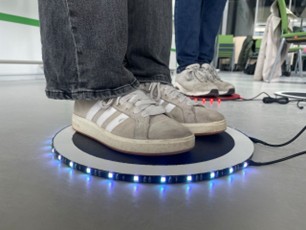
This group project was focused on designing an artifact for 6-till-12 year old children. Our goal was to positively improve the joining process which occurs when children have to divide groups by themselves, as for some children it might be difficult to join an established group. The artifact is operated via the body, meaning that there are no physical buttons or screens. The final prototype has been tested, using the ‘’Wizard-Of-Ozz’’ technique.
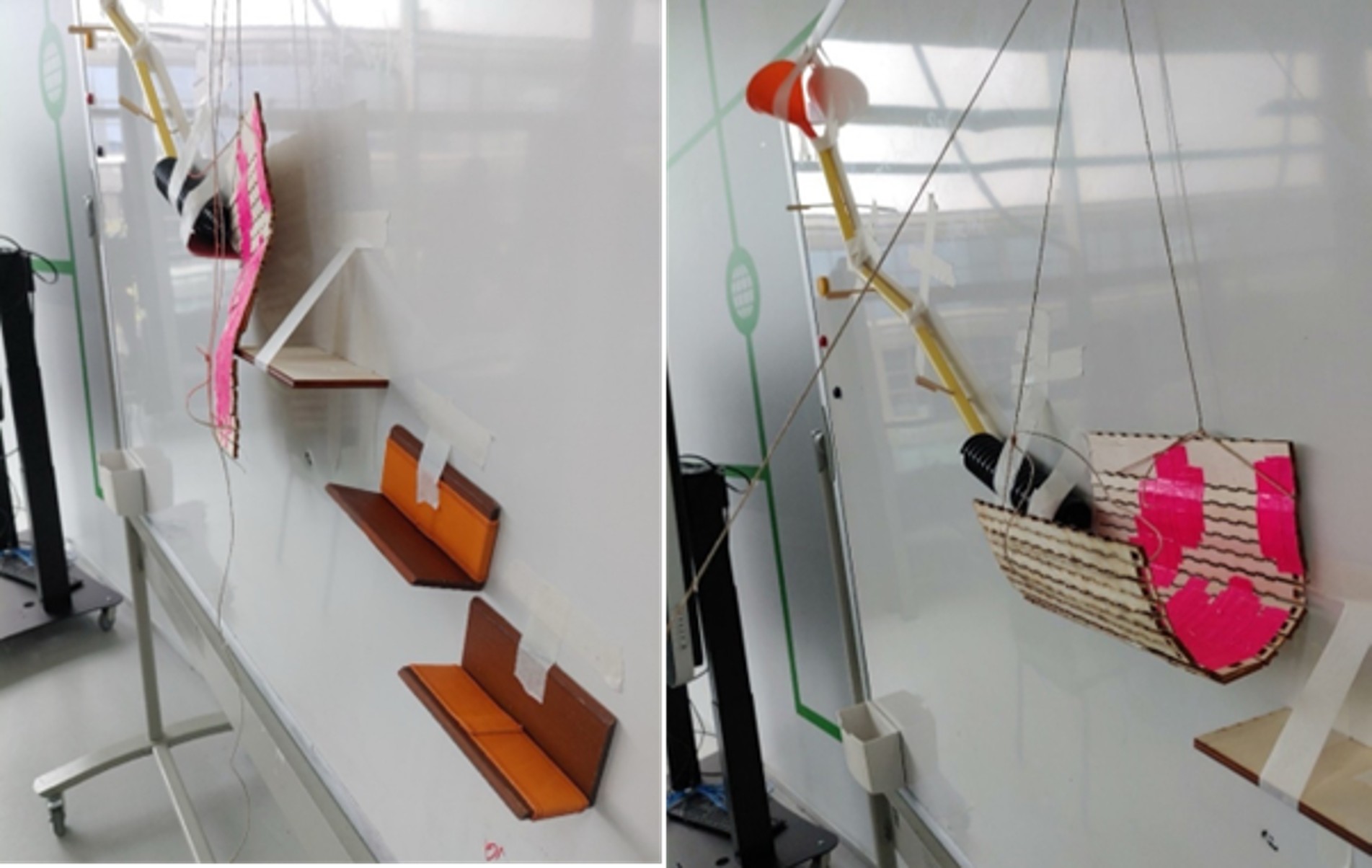
After deciding on a topic – improving the joining process during break time – the project started with creating a first prototype. During this ‘’thinkering’’ session we had to use our own knowledge, as we did not yet have had time to do a literature review on the target group and context of the problem. The result was a prototype called ‘’RollTogether’’. It is a marble track which asks children to work together to get the marbles to the end of the track. Obstacles on the track made sure that the marbles are were not able to get to the end on their own.
After this session a literature research and observations were performed. Next to doing research on the target group and use context of the artifact – this was mainly performed by doing observations – we chose here theories we wanted to incorporate in the design. These were the theories of Participatory Sensemaking – which explains that together people give meaning to an object, this meaning can differ from the intention of the designer -, Affordances – which tells that every object evokes an action by its user. The designer can use this theory for designing – and External Representation – which explains that objects can be used to bring the thinking process out of one’s head and into the environment. Based on this literature a new concept, called ‘’CircleUp’’, was developed.
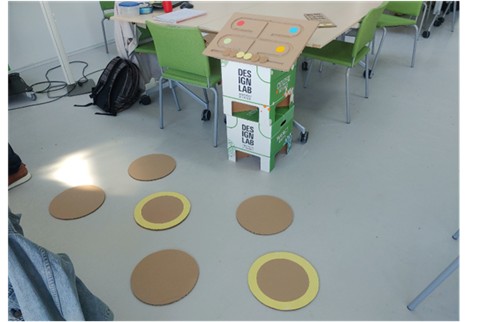
The concept consists of multiple tiles – with built-in LEDs – and a control panel. Children can activate the tiles by stepping onto them. This will activate a white light. After a set time the system will lock and the control panel will be activated: the amount of lighted buttons is equal to the amount of activated tiles. Children can divide the teams by moving the buttons towards the colours of choice. Then, the system will randomly divide the colours over the tiles based on the given ratio. This concept was made into a cardboard prototype.
After a midterm presentation where feedback was provided, the concept was further developed into a working prototype. The control panel was removed and children would be able to control the artifact by jumping and stamping on the tiles. The final prototype of ‘’CircleUp’’ consists of eight tiles: six with a white border, one with a red border and one with a blue border. The tiles with the coloured borders are the starting tiles. When these are activated the corresponding colour will be one of the available team colours. Children standing on a tile with a coloured border – all tiles expect the white ones – are able to add children to their team by stamping once on the tile. By doing this a nearby, white tile which change colour to match the starting tile, for example blue. When all white tiles have a colour, the system will randomize the colours of the tiles to create random teams. If a child is not content with their team they can stamp once on the tile. The tile will start to blink. If a tile of another colour is blinking as well, the two tiles will swap colours. In case the majority of the children stamps on their tiles the system randomizes the colours again.
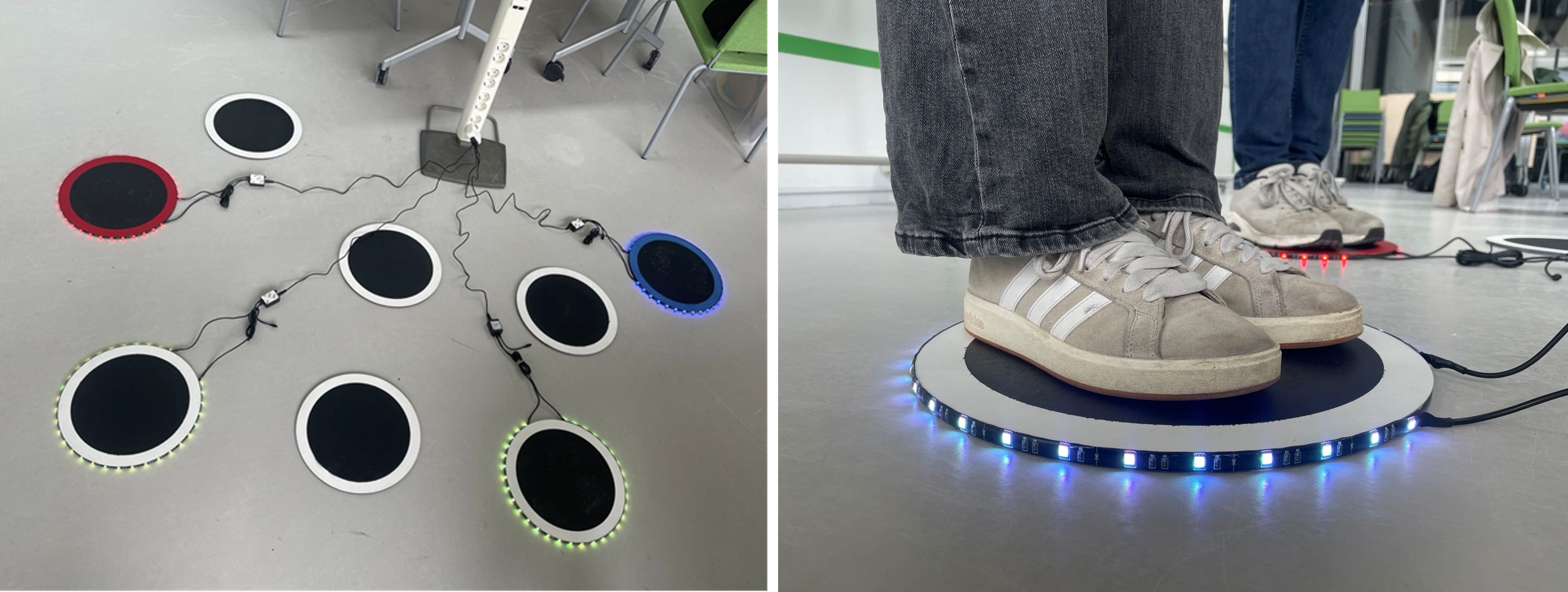
The prototype has been tested via the ‘’Wizard-Of-Ozz’’ technique. This means that the LEDs of the tiles are controlled manually. This made it possible to incorporate improvisation where we tested various input- and output options for the system. For example, some participants took each other’s hands during the session. The ‘’Wizard’’ – controller of the system – was able to react on this by making all tiles the same colour.
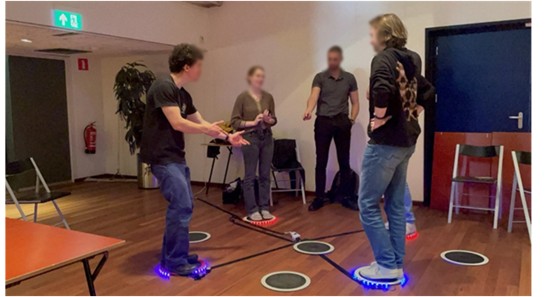
The complete process, including all findings and reflection, have been written out in a scientific article. The article can be found via the button below.
Personal contributions to the project
The main part of the project consisted of joint activities. Creating the prototypes, for example, was done during group sessions. However, the literature research was divided into separate parts. I focused mainly on the theory of External Representation. Next to this, I searched for related work which could be used for the development of the concept. Lastly, I did observations in which I watched for the non-verbal communication between children while playing. Doing this project I learned to use the Research-Through-Design method – creating prototypes during the process to deepen your understanding of the theory. Next to this, I practiced with executing a testing session in which the ‘’Wizard-Of-Ozz’’ technique is performed.