LEAFE
Multisensory Design - 2025
Within this group project, we explored how multisensory design could be used to support wayfinding for people with dementia in a care facility. The project was carried out in collaboration with Zwanenhof, a care facility in Zenderen. Conversations with the organisation revealed that residents can become disoriented within the building and may have difficulty independently finding their way to a desired destination. For this project, we specifically focused on the route from the residential area to the garden.
Our goal was to design a form of wayfinding that could guide residents outside in an intuitive and calming way. An important consideration was to avoid overstimulation and instead create a balanced combination of different forms of sensory stimulation. Based on literature research and conversations with the care facility, we formulated several design principles, including multisensory balance, intuitive wayfinding, calm environments, familiarity, and safe mobility.
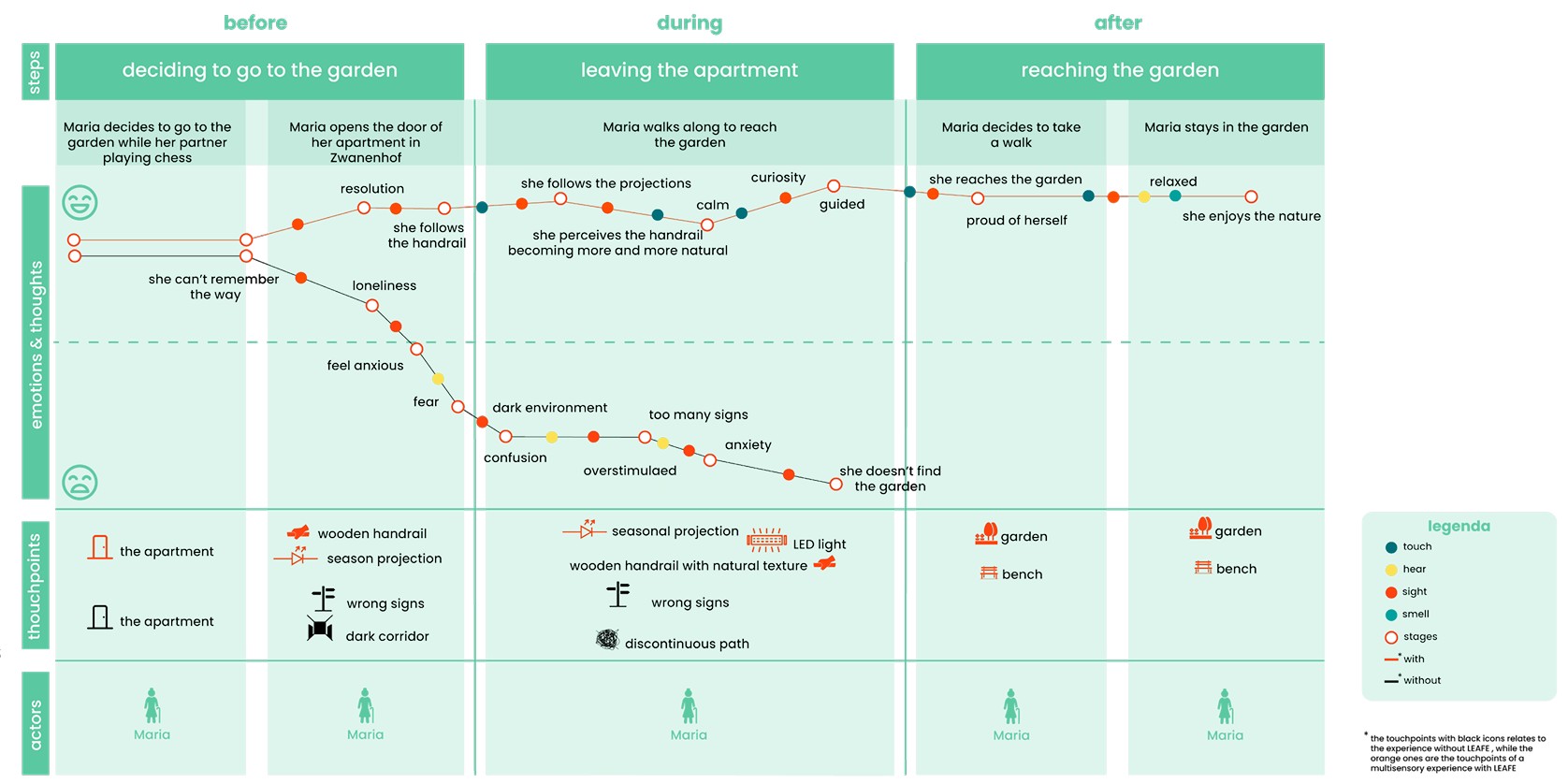
To better understand the user's experience, we developed, among other things, a persona and a patient journey. We then explored different directions through ideation sessions and concept development. This resulted in several ideas for a nature-inspired navigation system, including solutions integrated into the wall, projections, and a physical handrail. Ultimately, the handrail offered the greatest potential for combining different senses in a subtle way.
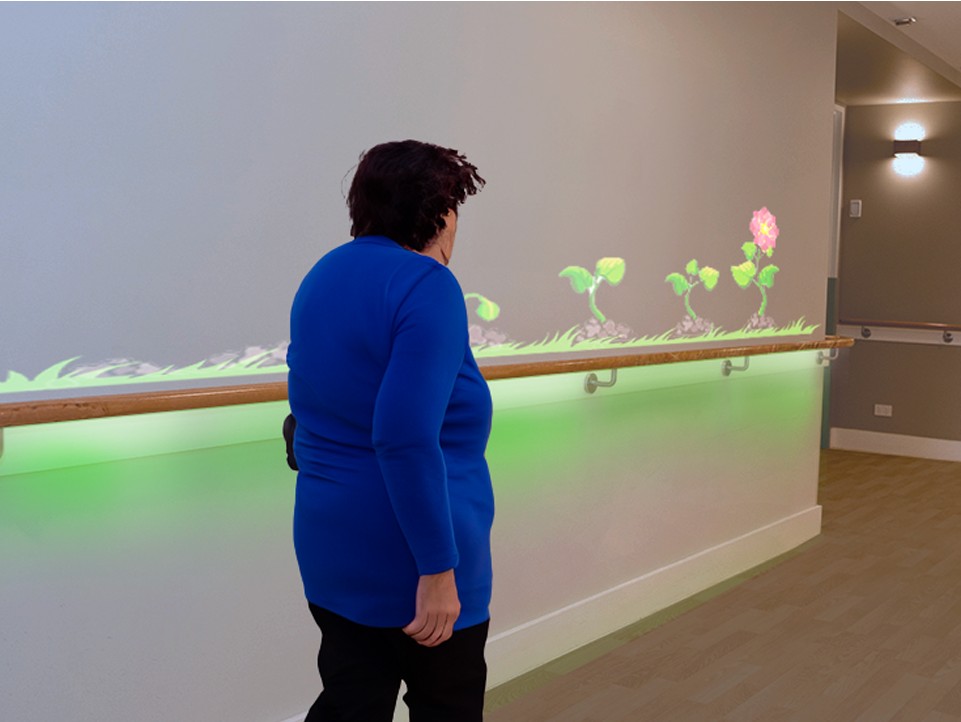
The final concept was named LEAFE: A Guide to the Outside. LEAFE is a tactile and visual handrail system that gradually guides residents towards the garden. The wooden handrail incorporates increasingly prominent nature-inspired textures as the user gets closer to the exit. In addition, subtle LED lighting beneath the handrail provides visual guidance. Sensors detect movement, allowing a wall projection to respond to the direction in which a person is walking. The nature-inspired visuals gradually become more prominent as the user approaches the garden.
By combining tactile, visual, and interactive cues, LEAFE was designed as a familiar and subtle form of wayfinding. The handrail retains its original function of providing physical support while walking, while its changing textures and visual elements simultaneously provide a sense of direction. The aim is to give people with dementia greater independence and confidence when navigating their environment.
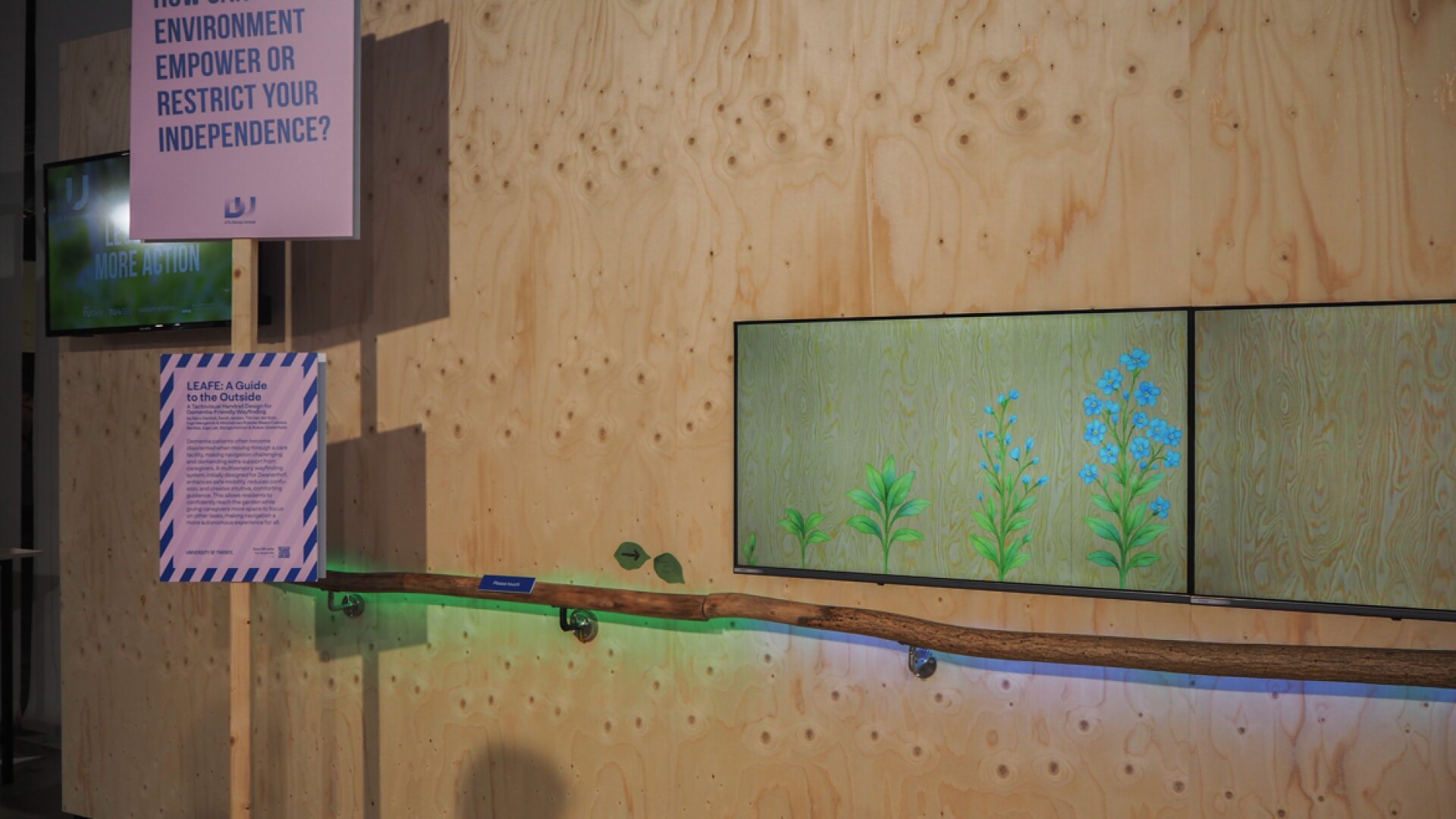
The concept was ultimately selected for the Dutch Design Week 2025, where LEAFE was presented as part of the 4TU Design United Expo. The DDW presentation describes LEAFE as a multisensory handrail system that combines texture, light, and projections to support intuitive wayfinding and independence.
LEAFE's contribution on Dutch Design Week can be viewed by clicking the button below.
Personal contribution to the project

LEAFE was developed within an interdisciplinary team. During the early stages of the project, I mainly focused on conducting literature research on multisensory design and wayfinding for people with dementia. Together with the rest of the team, the insights from this research formed the basis for the design principles and further concept development. I also contributed to generating and further developing various concepts.
During the final phase of the project, my main contribution focused on realising a working prototype of LEAFE for Dutch Design Week 2025. Together with the team, I worked on translating the concept into a physical and interactive installation in which the different sensory elements came together. The prototype was subsequently exhibited at Dutch Design Week, where I was also present to present the project to visitors.